
How I Turned Wedding Invitation Envelopes Into a Vintage Blue Junk Journal

A handmade vintage blue envelope junk journal — wedding invitation envelopes, floral imagery, lace, interactive pockets, and shabby chic details by Savera.
A handmade journal of blue envelopes, faded florals, lace, hidden papers and little things waiting to be discovered
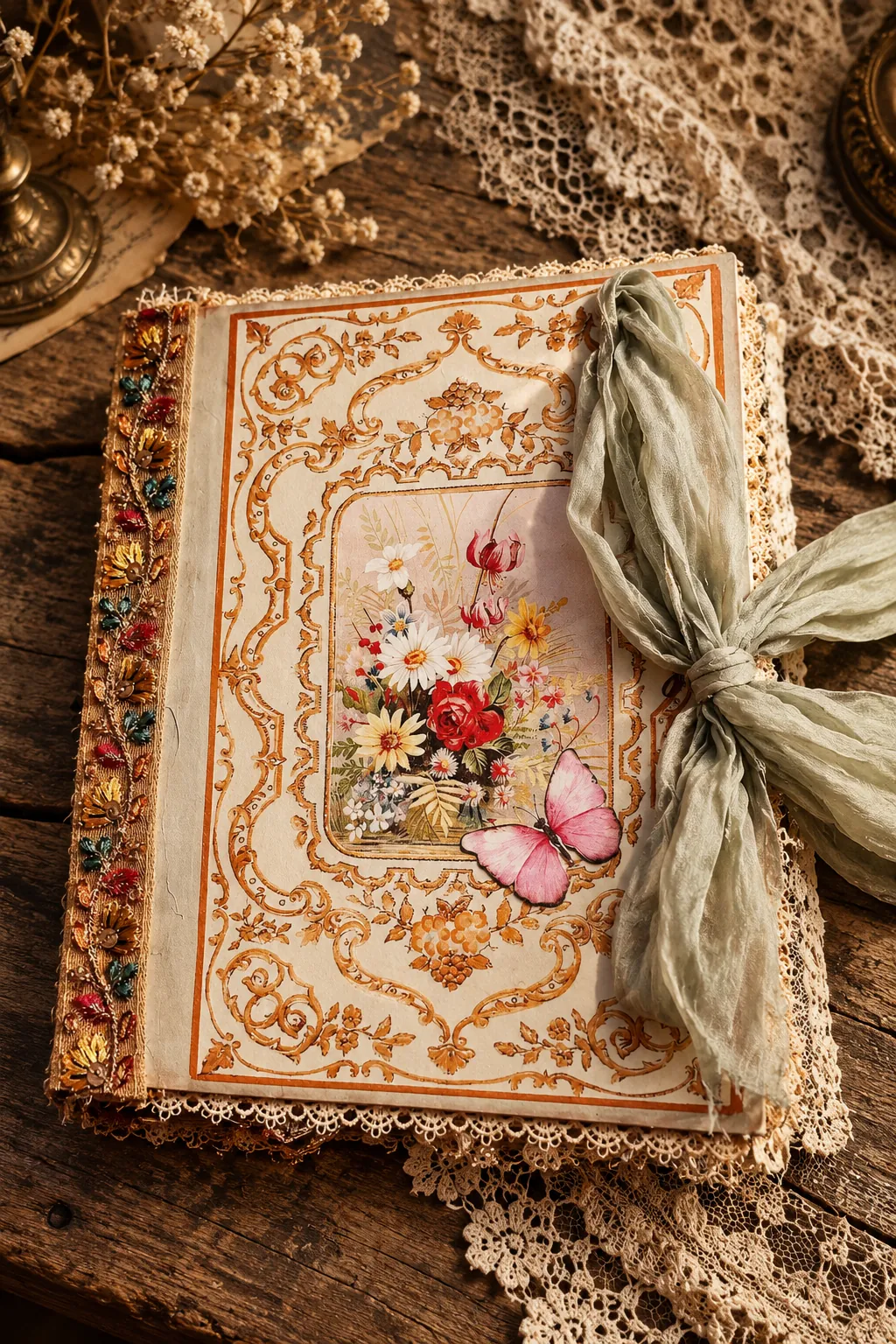
I have always loved the idea that something made for one purpose can quietly become something entirely different in a journal.
And that is really where the story of this one begins.
At the beginning of 2023, I had a collection of beautiful light-blue envelopes. They had originally been meant for wedding invitations, but instead of becoming part of a wedding suite, they found their way onto my craft table.
When I looked at them, I didn't really see unused envelopes anymore.
I saw pages.
I saw pockets.
I saw flaps that could open to reveal other things.
I saw all those wonderful little secret places that make you want to keep exploring a handmade journal.
So, for the first journal I made that year, I decided to build almost the entire structure around them.
The result was this soft blue, pink and cream journal — full of florals, lace, printables, old-looking papers, removable booklets, tags, tiny envelopes, writing spaces and things tucked inside other things.
And perhaps that is what I still love most about it.
You never quite see everything at first glance.
It Started With a Tutorial — and a Stack of Blue Envelopes
I was inspired to try this style of construction after watching Iva from Bohemian Crafting. I loved the way envelopes could become much more than pockets and could actually help form the structure of a journal.
The beautiful blue envelopes I already had seemed perfect for it.
Once that decision was made, the rest of the journal began developing almost instinctively around their colour.
I brought in blush pinks, creams and soft greens. Then came florals, lace, bits of gold, embroidered trims and vintage-inspired papers.
Some of the digitals I used are from Amity Bloom, along with a few others that I mentioned with the original video.
There is also something I said in the video that I think is worth repeating here.
I don't have an enormous collection of genuine antique documents.
Most of what looks old inside this journal is actually printed ephemera.
And I think that matters, because sometimes when we look at richly layered journals online, it can feel as though we need drawers full of authentic Victorian letters, ledgers and postcards before we can create something beautiful.
We really don't.
A printable, a piece of ordinary paper, an embossed tag and a little imagination can go a very long way.
The Cover That Set the Mood
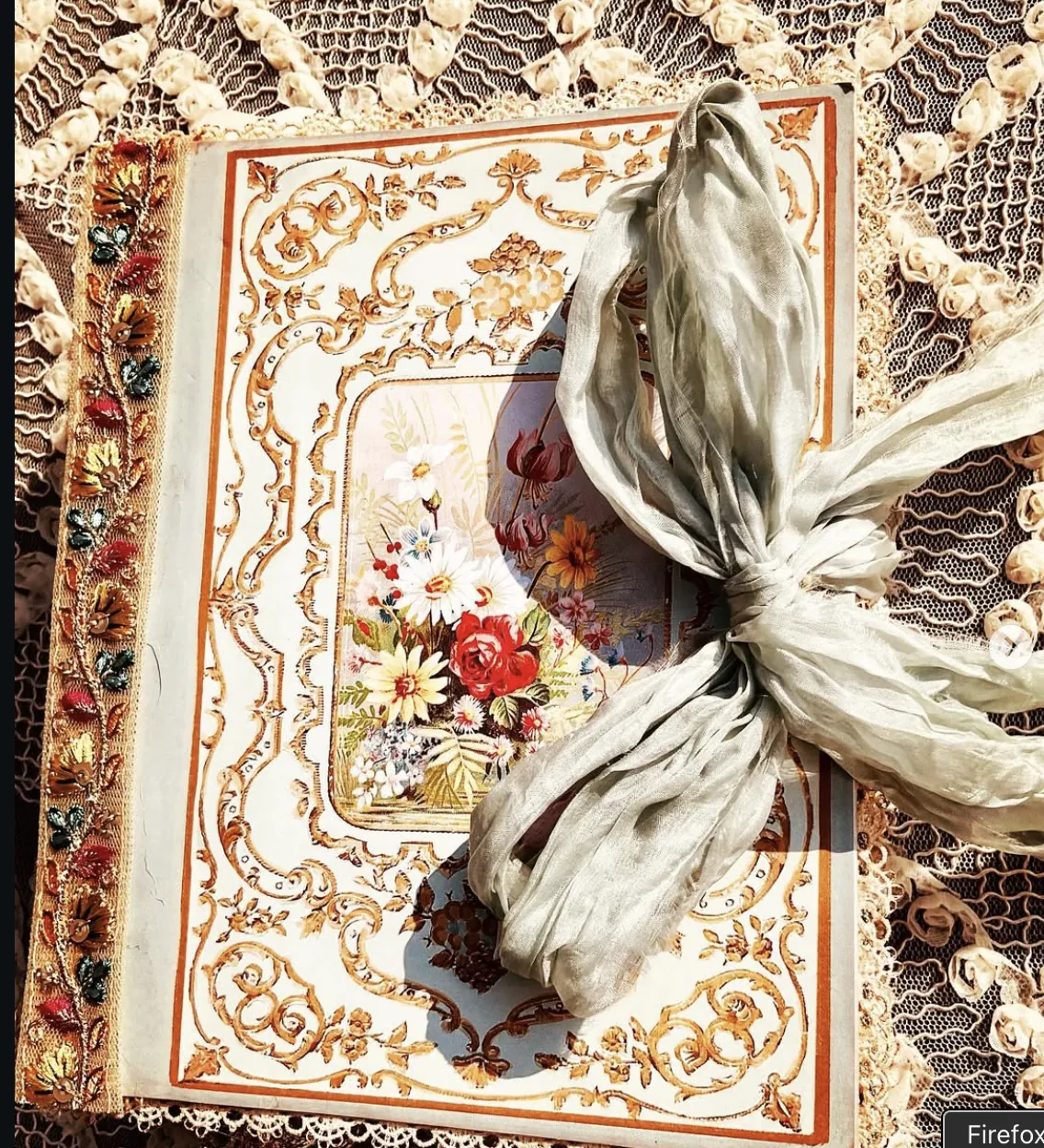
The cover established the entire feeling of the journal before I had even opened it.
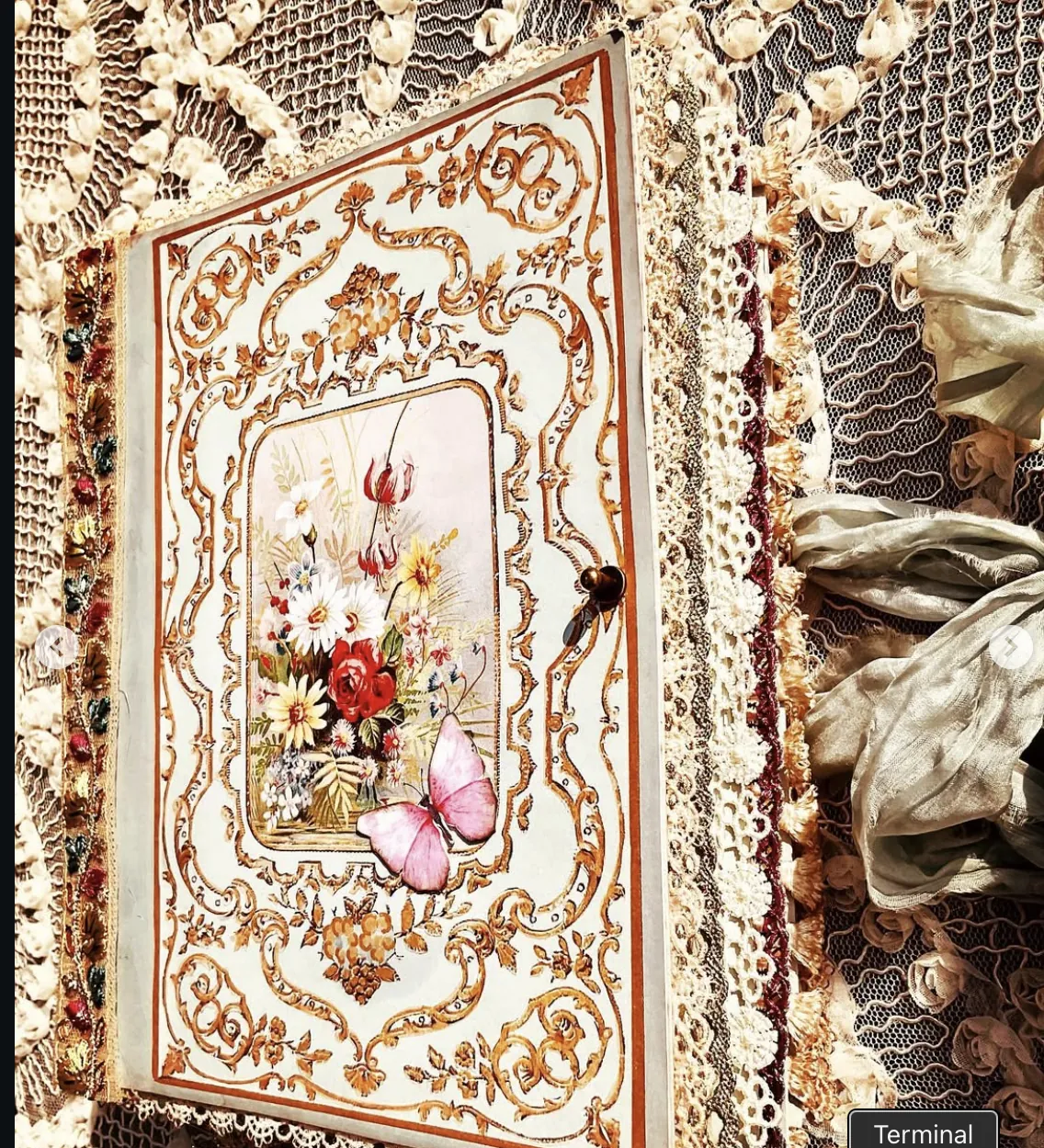
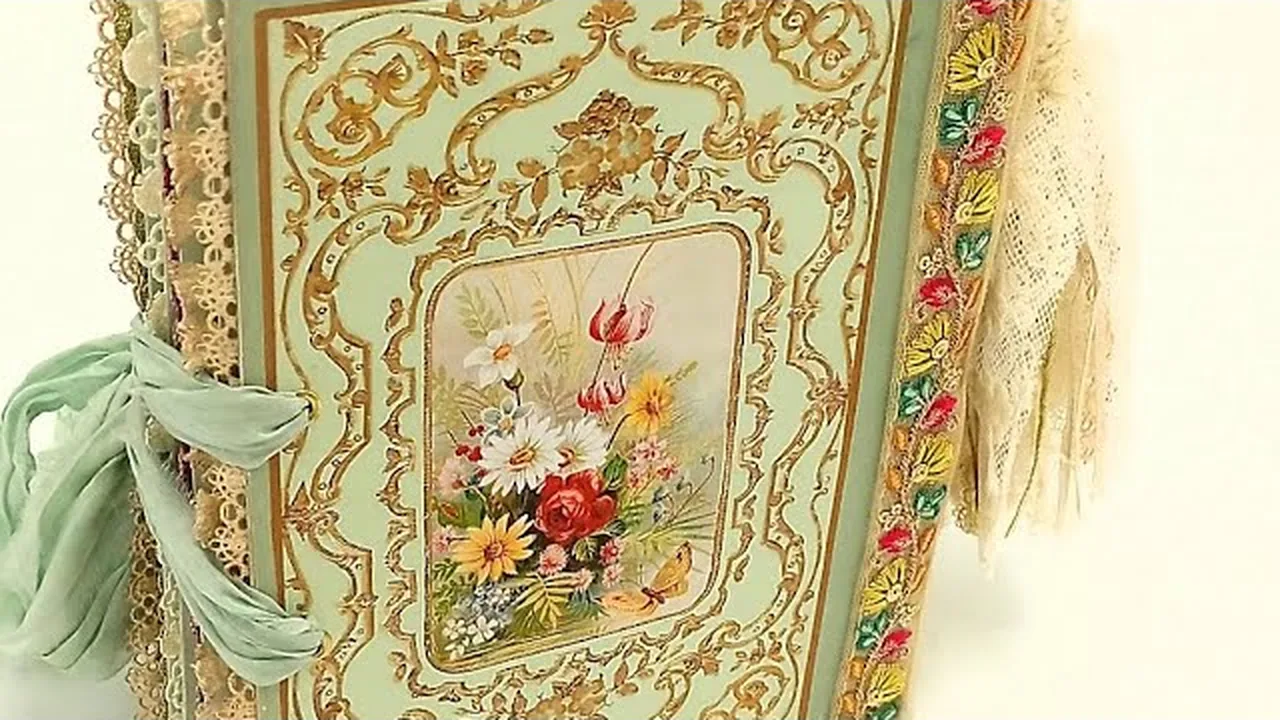
The blue became a backdrop for an ornate floral design, with wildflowers framed by delicate decorative details and a dimensional pink butterfly sitting amongst them.
Along the side I added an embroidered trim that brings together the colours running through the journal — gold, teal and pink — and then softened the edges with lace.
The closure is a long, crinkled ribbon in that lovely muted blue-green shade.
But the spine may be my favourite part.
I used a rich gold embroidered trim with those wonderful large turquoise details, and then added a pearl pin and a hanging lace-and-bead tassel.
There are even tiny iridescent drops hanging from the lower edge.
It became quite an embellished journal, but I didn't want the embellishment simply sitting on top of the book.
I wanted it to feel as though all these pieces belonged together — almost as if the journal had slowly collected them over time.
Opening the Journal
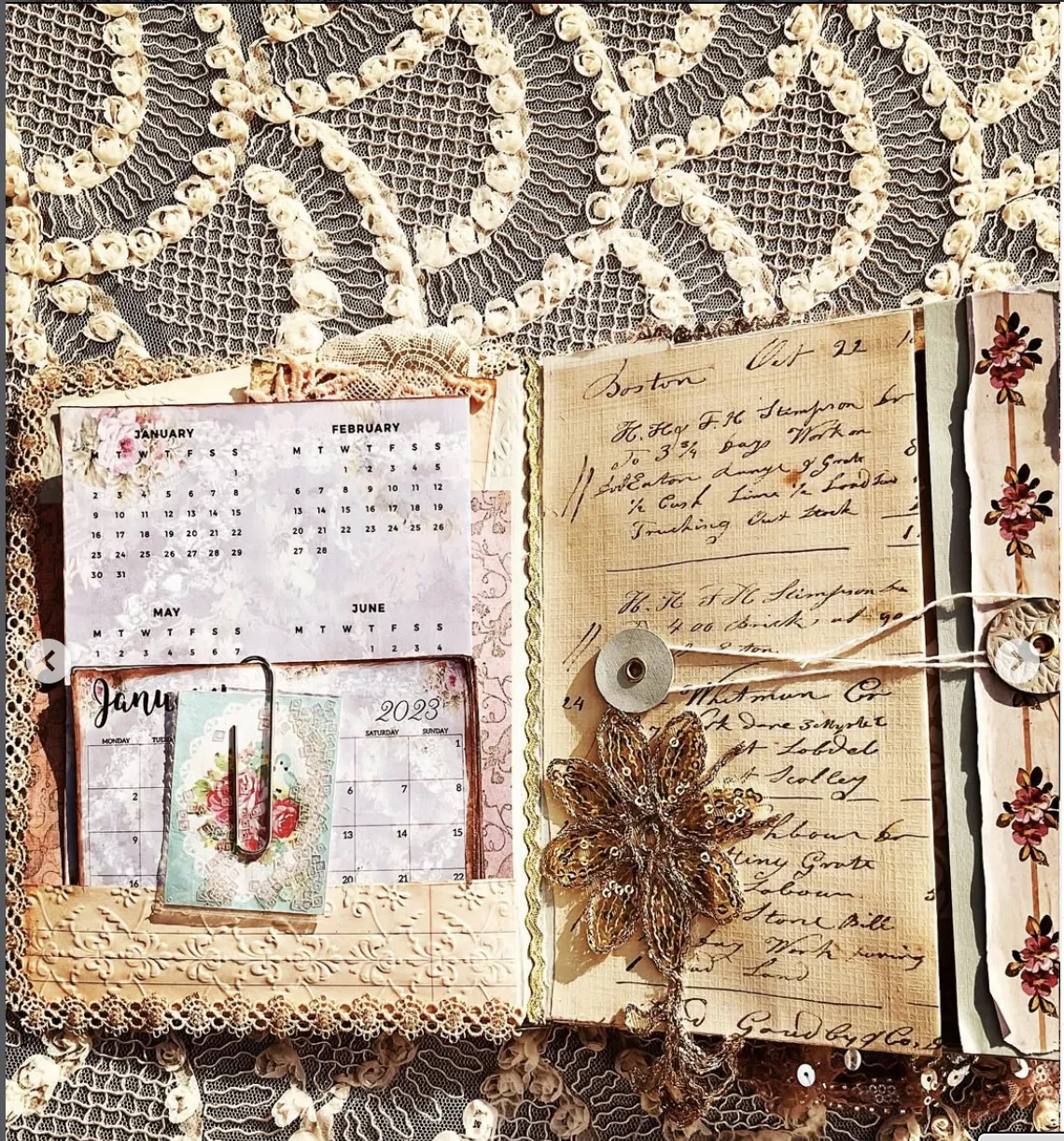
The first thing you find when you open it is a little reminder of when this journal was made.
Inside the front pocket I placed a miniature 2023 calendar, clipped with a floral paperclip, together with a larger fold-out calendar.
I love dated pieces inside journals.
Even when they are small, they fix the book to a particular moment. Years later, that tiny calendar may tell more of the story than any elaborate embellishment could.
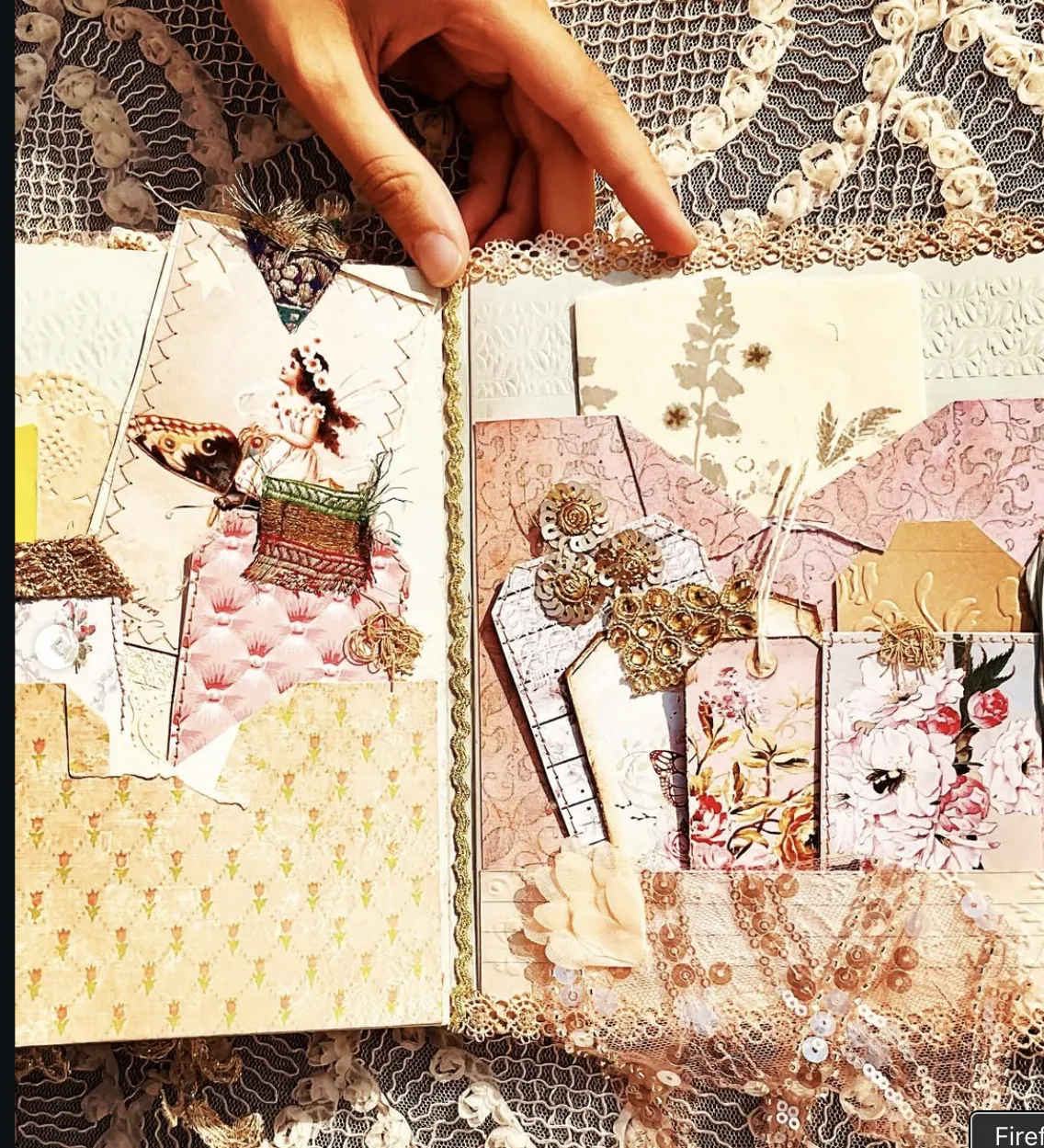
Opposite it is one of the ledger-style pages, with old script in the background, lace along the edge and a decorative metal charm.
There are button-and-string details here too, and tucked into the pockets are cards and little pieces that can be taken out and written on.
And that is really where the character of this journal begins to reveal itself.
It isn't a book you only look at.
You have to open it.
Untie things.
Pull things out.
Look underneath.
An Envelope Becomes a Door
One of the reasons I enjoyed making this journal so much is that the original envelopes never disappeared beneath the decoration.
I let them remain part of the experience.
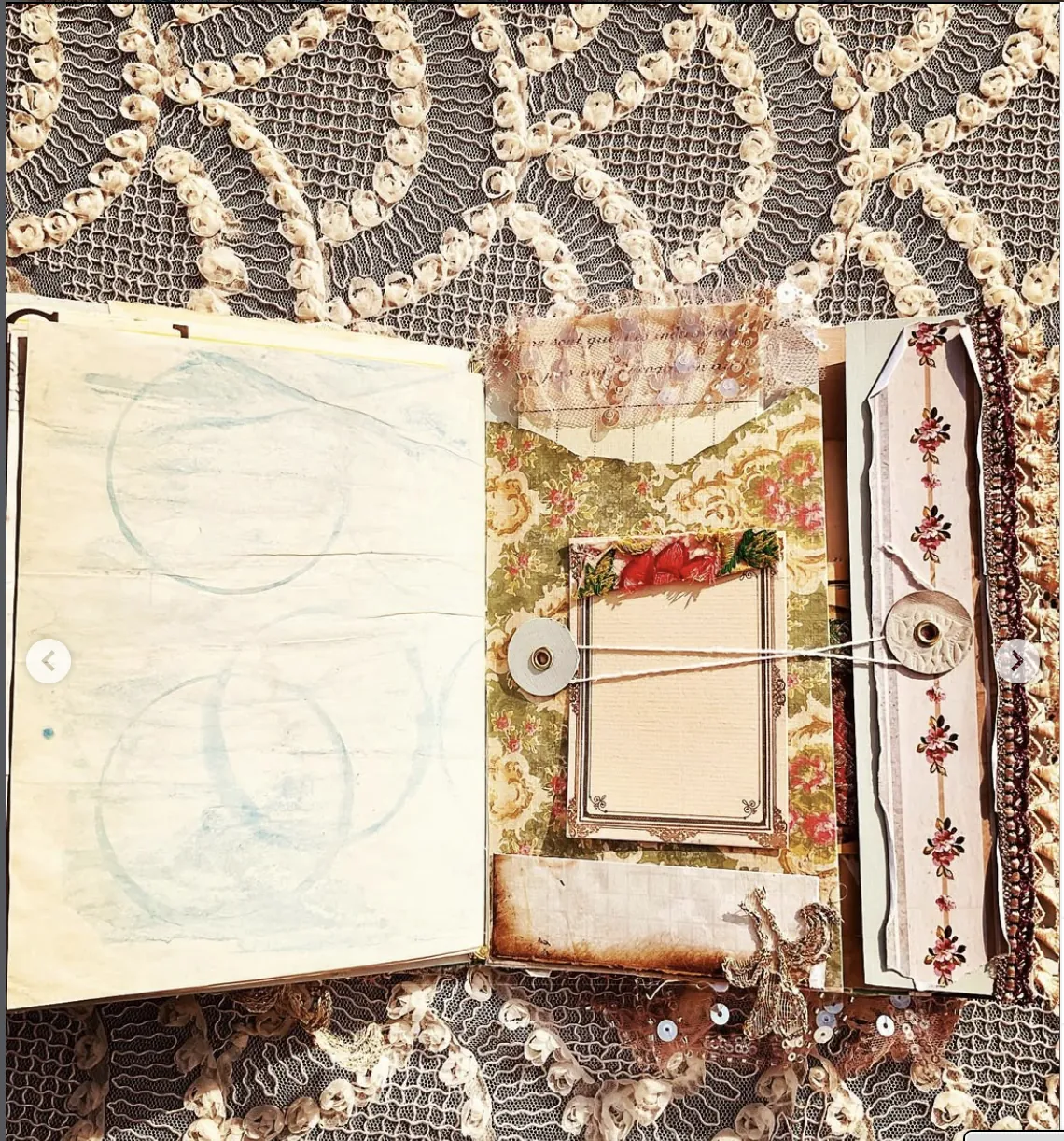
A blue envelope flap opens and suddenly there is another pocket waiting underneath it.
Inside that is a tiny folded envelope holding vintage-style pieces, botanical papers and postmarked ephemera.
Then, tucked on the other side, is a small floral booklet with the word DREAM sitting in the centre.
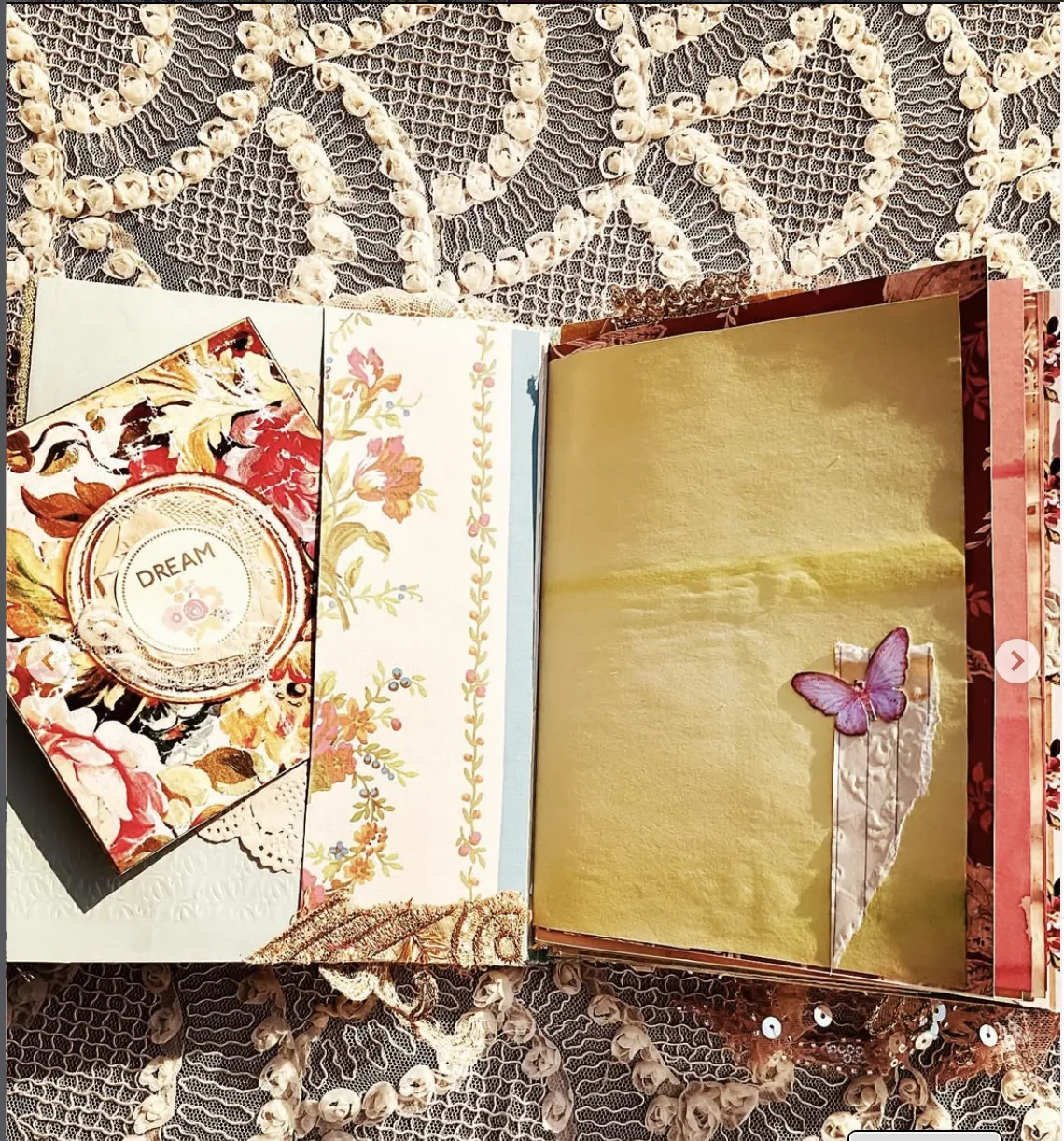
I love this kind of layering because the page doesn't reveal itself all at once.
There is the composition you see first.
Then there is the thing you notice behind it.
Then perhaps there is another piece tucked inside that.
That little sense of discovery is one of the things I have always loved about journal making.
A Journal Inside the Journal
As the pages continue, the palette moves through white, tea-stained cream and soft pink.
There are stencilled patterns, little pockets and tags — and then you come to something I particularly enjoyed including: a removable inner signature held inside the journal with an elastic.
It is almost a separate notebook living inside the larger journal.
Inside are butterfly pages, tea-stained papers, blush pink sheets and softly stencilled borders.
I like having these quieter areas amongst the more embellished pages.
A journal needs breathing room.
There should be places where the person who eventually owns it can add something of herself rather than every inch already having been decided by me.
Printables, Tea-Stained Papers and the Illusion of Age
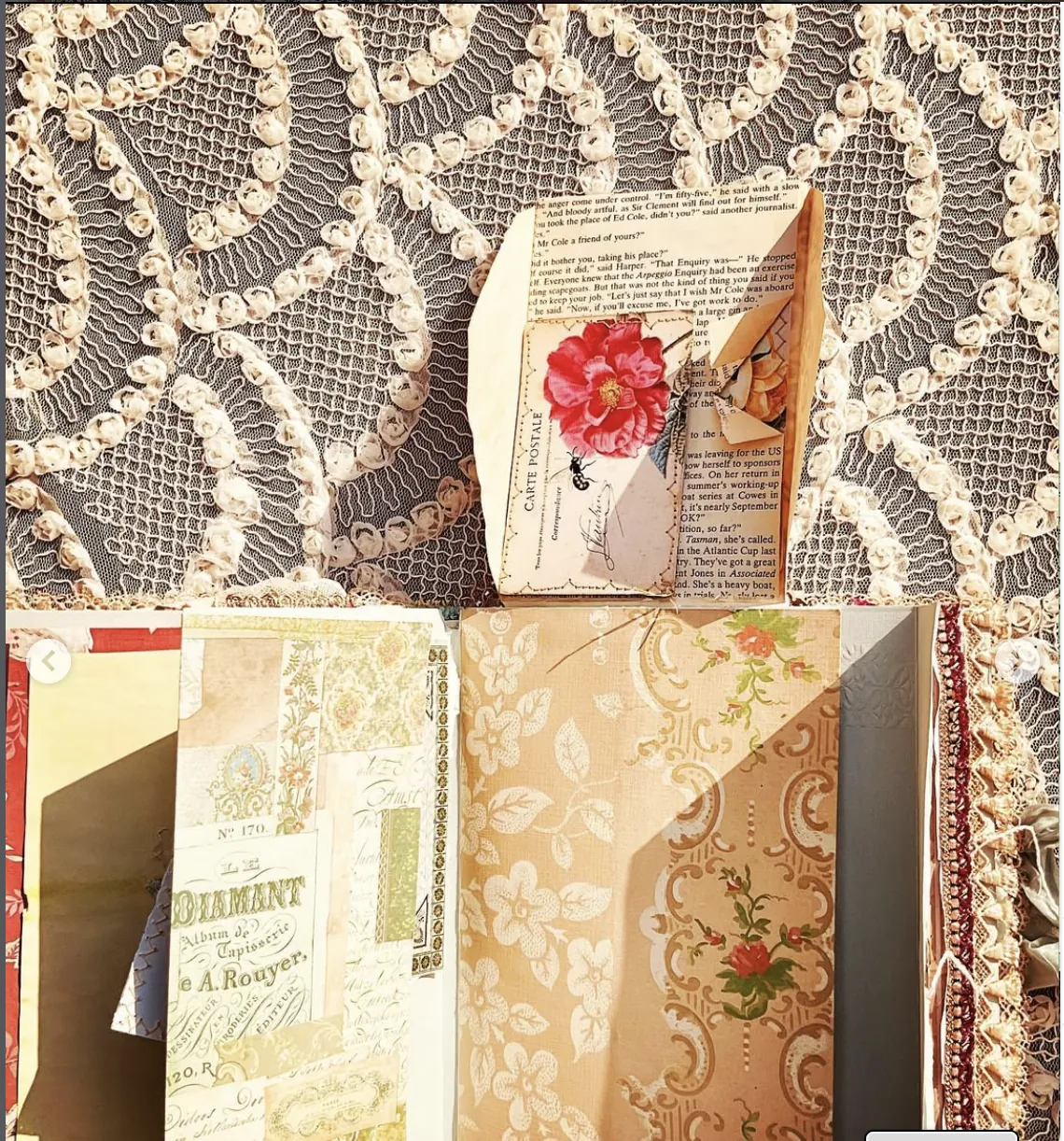
As you move further in, there are old book-page effects, ledger papers, French-style ephemera, botanical pieces, receipts and aged-looking documents.
But again, many of these began as printables.
I think that is part of the magic of this kind of work.
A freshly printed piece of paper doesn't have to remain a freshly printed piece of paper.
Once it is layered with tea-stained paper, stitched, distressed, folded into a pocket or placed beside lace and faded florals, it becomes part of another visual world.
On one spread I created a collaged pocket marked Original, filled with layered cards.
Another uses a book-page-style pocket over a softly stencilled background, with an embossed tag tucked inside.
None of these pieces is particularly complicated by itself.
It is the accumulation that changes them.
Buttons, String and Things Hidden Behind Flaps
There are several button-and-string closures throughout the journal.
I love using them because they slow you down.
Instead of simply turning a page, you have to stop, unwind the thread, open the envelope and see what has been kept inside.
One of these sections contains collaged French-style ephemera with writing cards hidden behind it.
Elsewhere, an upper flap opens to reveal an origami-style envelope made from a vintage book page.
Inside are botanical postcards and stitched journaling pieces.
These are tiny details, but collectively they change the way you experience the book.
The journal becomes less like a sequence of decorated pages and more like a little cabinet of curiosities made from paper.
Florals Begin to Take Over
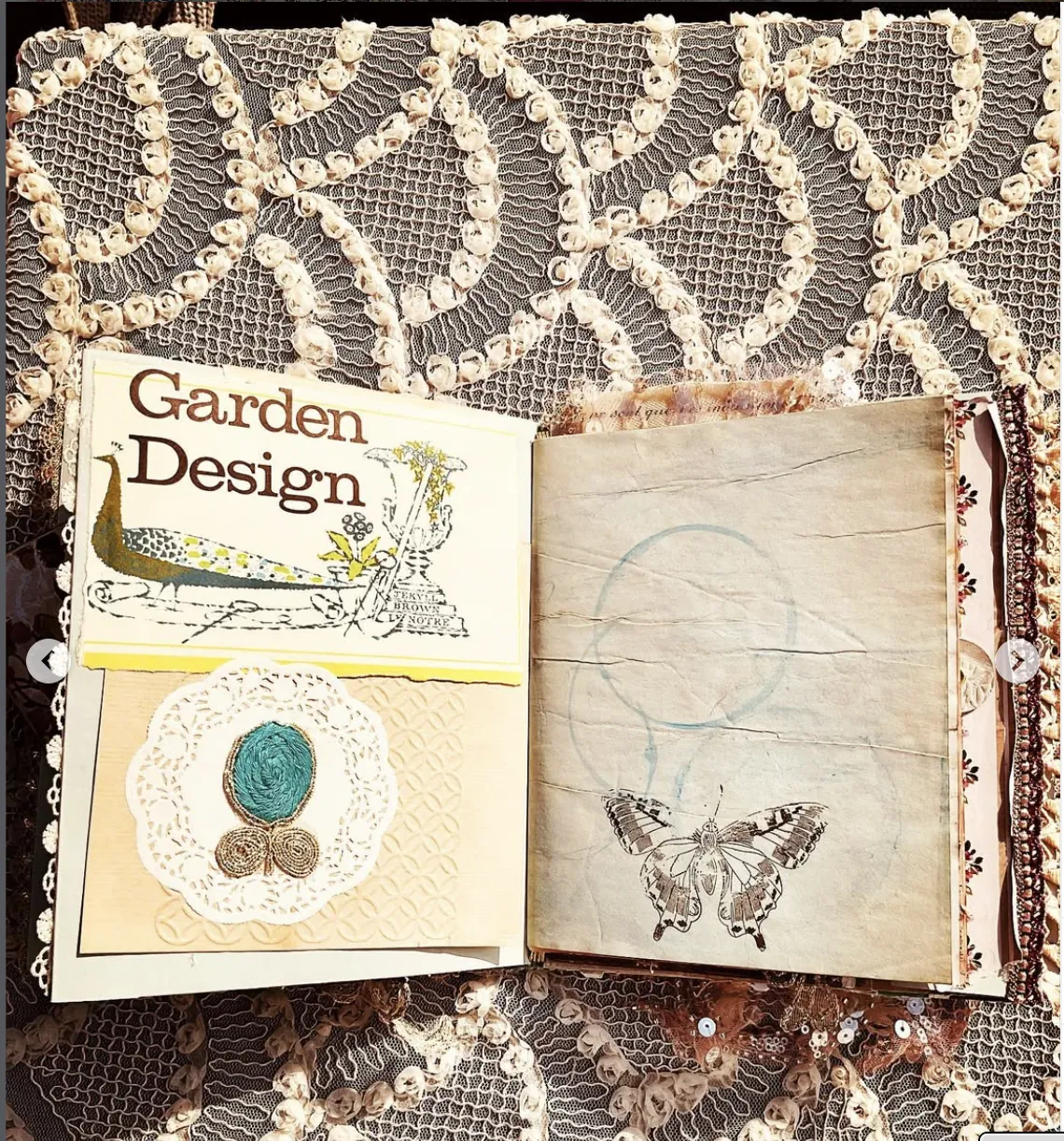
As I continued through the journal, the botanical theme became stronger.
There is a Garden Design pocket with a beautiful peacock image, holding an embossed card decorated with a teal jewel-like piece and a paper doily.
Across from it is a very pale blue page, almost like a faded watercolour wash, with a butterfly detail.
Then another envelope becomes a patterned pocket with its own string closure.
Inside are distressed receipt-style papers and stitched tags.
I wasn't trying to make every spread identical.
Quite the opposite.
I wanted there to be a relationship between the pages without making them predictable.
The colours repeat.
The florals repeat.
The lace and old paper repeat.
But what the page does changes.
The Pleasure of Making Things Open
There is a brown kraft-paper botanical insert, followed by another envelope flap that I decorated with white floral stencilling.
When that opens, you find folded booklets, old-script papers and a reproduction of an antique map or document tucked away inside.
And this is where the original wedding envelopes really proved how versatile they could be.
Instead of being something I had to disguise, every fold and flap gave me another opportunity.
Another place for a pocket.
Another place to stitch.
Another place to hide a paper.
Another little surprise.
"Darling, Remember to Bloom"
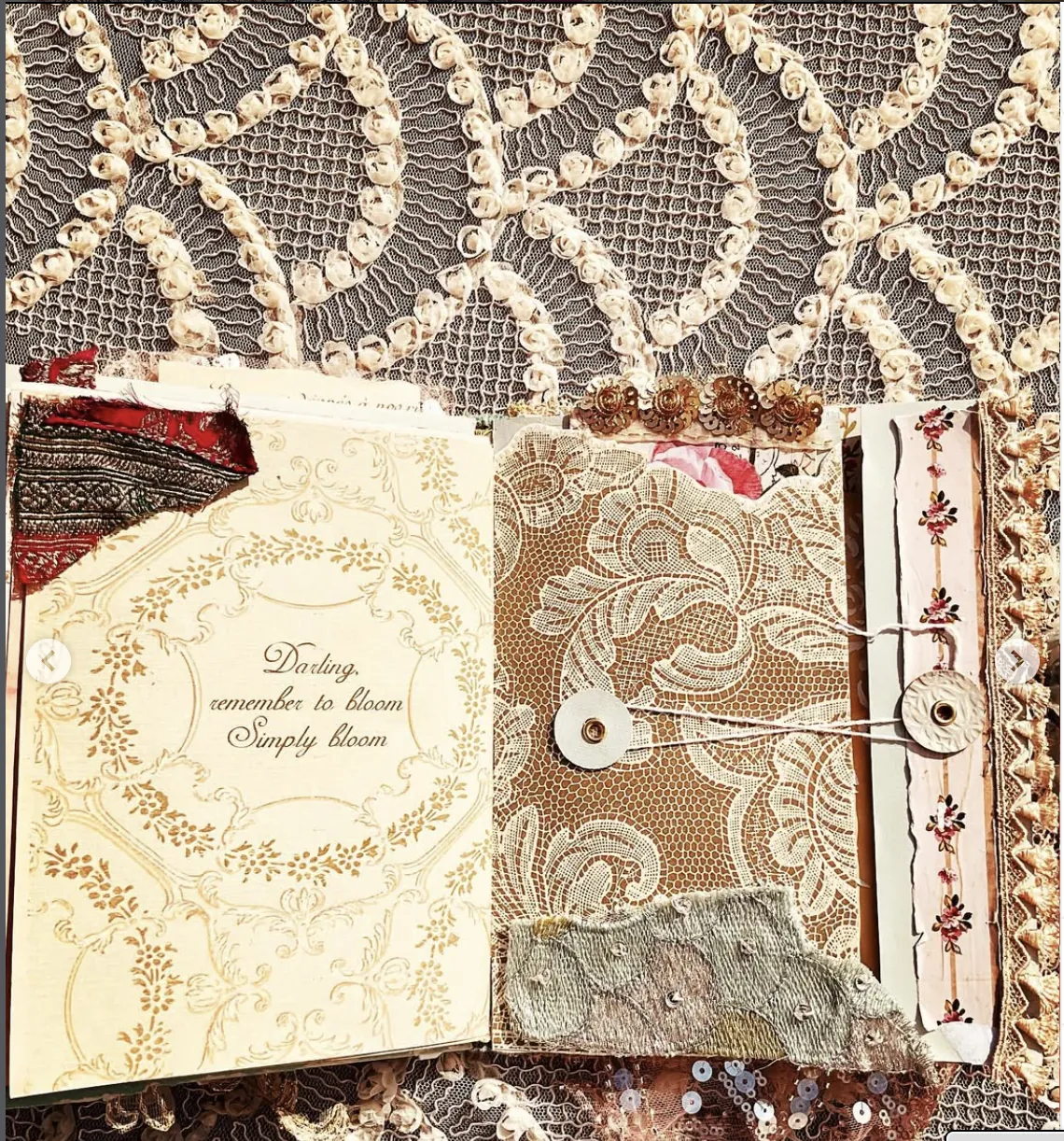
One of the prettiest moments in the journal is also one of the simplest.
Against all the layered pockets and ephemera is a page carrying the words:
"Darling, remember to bloom."
Beside it are those wonderful floral elements that run throughout the journal.
There is a large magenta flower pocket, folded French-style papers and rose-patterned writing pieces.
Then another envelope opens.
Inside is a stitched lace pocket holding large rose-topped tags, gold-beaded details, receipt-style papers and folded botanical writing sheets.
By this stage, the journal has almost become a collection within a collection.
The Last Pockets Are Full of Little Treasures
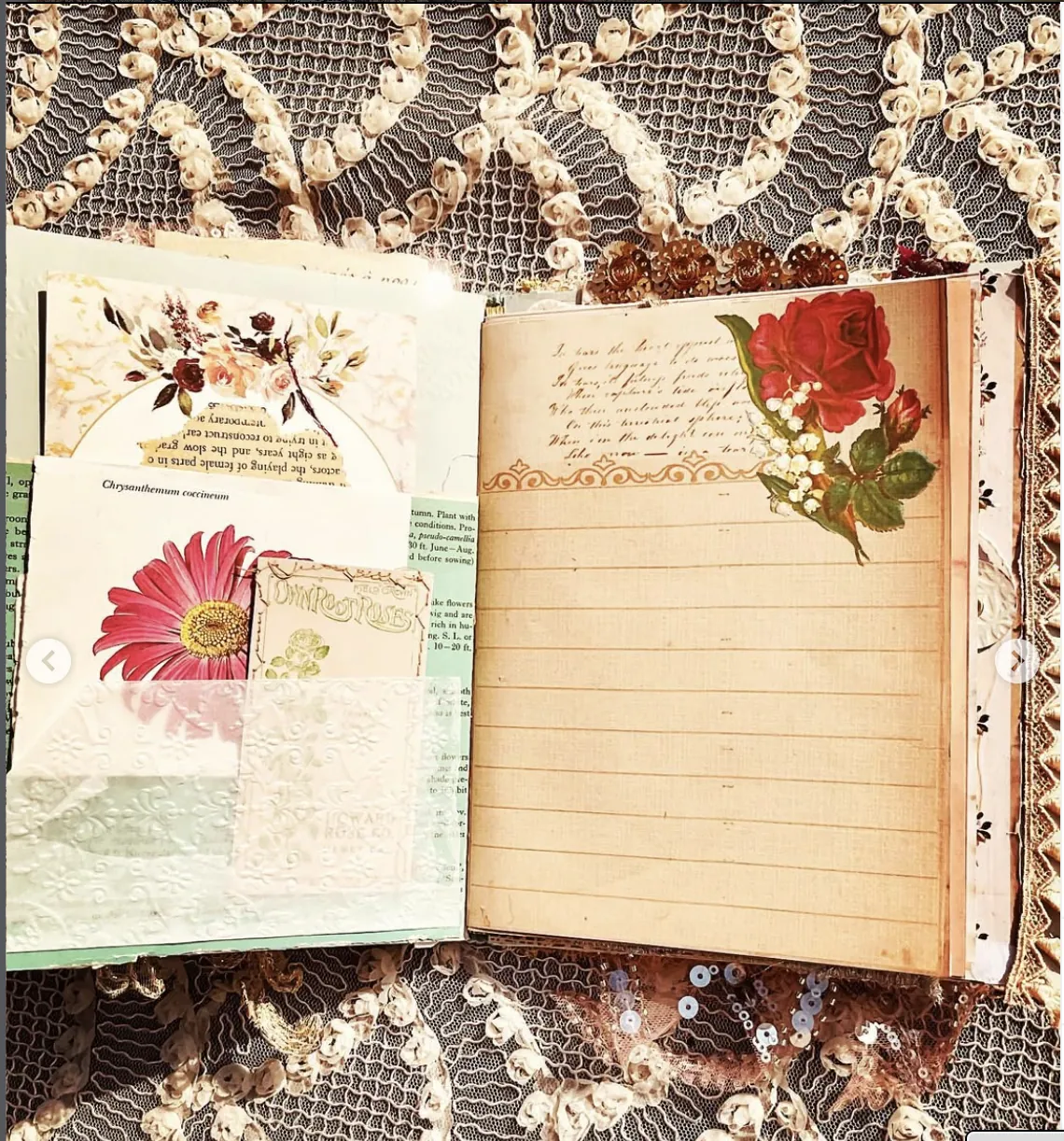
Towards the back I filled the pockets quite generously.
There are stitched cards edged with lace.
Butterfly and fairy-style pieces.
Ledger papers.
Floral tags.
A butterfly tag with a wood-plank effect.
A large rose-covered sheet that unfolds to give you another place to write.
And then there is that lovely sequinned lace trim catching the light amongst all the paper.
I think these final pages capture what I enjoy most about this sort of journal.
There isn't really one "important" object.
It is a collection of small things.
A tag.
A scrap of lace.
A folded piece of paper.
A printed rose.
A tiny card.
A ribbon.
Things that would be insignificant alone become meaningful because of the company they keep.
Why I Still Love This Journal
Looking back at this journal now, I don't think what makes it special is any one technique or supply.
It is the transformation.
Wedding invitation envelopes became the structure of a book.
Ordinary printed papers began to feel old.
Little scraps became pockets.
Lace became an edge.
A button became a closure.
A collection of separate materials slowly became one object with its own personality.
And because this was the first journal I completed in 2023, it also holds that particular feeling of beginning again — sitting down at the start of a new year and making something simply because an idea has caught hold of you.
That, for me, is one of the best parts of making journals.
You don't always begin knowing exactly what the finished book will become.
Sometimes you simply begin with an envelope.
You Don't Need a Collection of Genuine Antiques
If there is one thing I would want another journal maker to take away from this project, it is this:
Use what you have.
You do not need drawers filled with genuine vintage documents to create a journal with history and atmosphere.
I certainly didn't have them here.
Printables can be beautiful.
Modern lace can sit beside tea-stained paper.
A plain tag can be embossed.
An unused envelope can become the architecture of an entire book.
What gives those materials character is what you do with them — how you combine them, layer them and give them a new context.
The story doesn't have to exist in the supplies before you begin.
Sometimes you create the story yourself.
Want to Build a Journal Around What You Already Have?
If you've collected papers, fabrics, trims, printables and little pieces but aren't quite sure how to bring them together, the Trinketz Kit Builder can help you develop a cohesive journal kit before you begin.
It can help you think through your colours, papers, textures, focal pieces and ephemera so the collection feels connected rather than random.
Watch the Full Vintage Blue Envelope Journal Flip-Through
There are so many small opening flaps, tucked papers, textures and hidden details in this journal that photographs can only show part of it.
In the original video, I take you slowly through the complete journal, opening the pockets and removing the pieces so you can see how everything works together.
And as I said when I finished that first flip-through, I'd love to know what you think of the ideas inside it.
Thank you for stopping by and spending a little time with me — and with this rather unexpected collection of wedding envelopes that found an entirely different life.
What Customers Say
“Beautiful journal, made very well. Packaged nicely.... Thank you!!!”
— Deanna Mills
“Beautiful journal, every page is an explosion of color, texture and creativity. I bought journal #2 in blue. I'm so happy with my purchase.”
— Linda Armbruster
“Beautiful as described and shipping arrived faster than expected. Great seller, lovely packaging - such a lovely creative and thoughtful junk journal...”
— Stephanie Weyant
More from Dear Trinketz


Leave a comment
I’ll use your details to reply to your comment. Privacy Policy