
How Old Pakistani Wedding Invitations Became Handmade Folio Journals
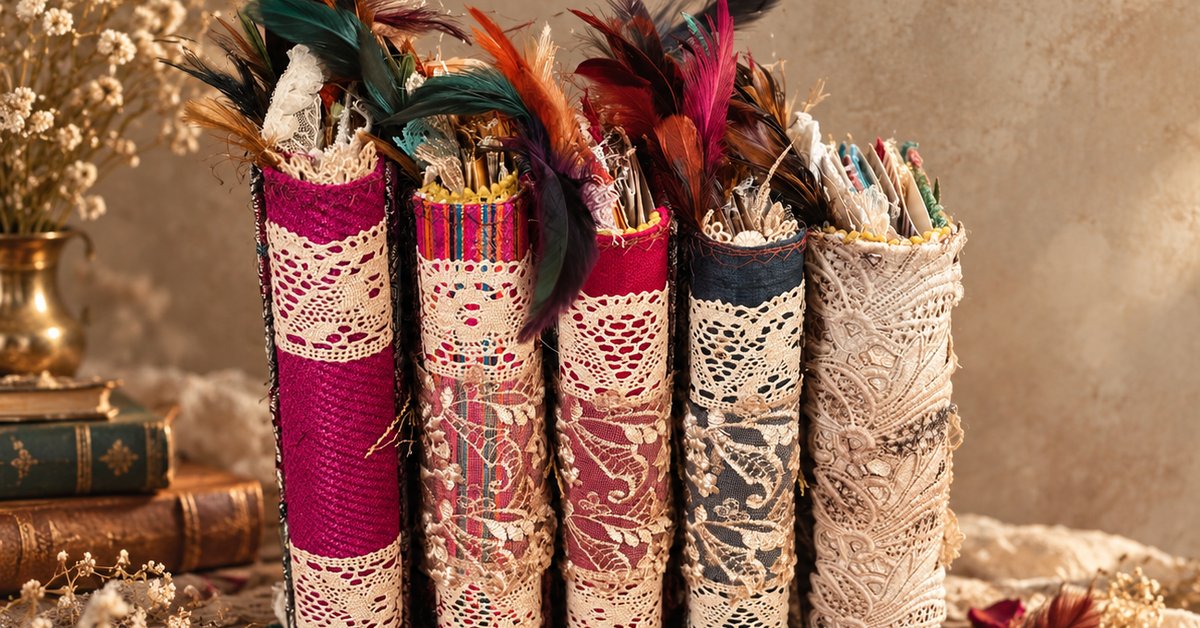
How old Pakistani wedding invitation envelopes, with their embossed wedding scene, became handmade folio journals of lace, vintage paper and story.
Three envelopes, an old wedding scene, scraps of lace and paper — and a little piece of Pakistan preserved inside a handmade book
Sometimes the most interesting material in a journal already has a story before I ever touch it.
These journals began with something I had been keeping for years: old wedding invitation envelopes from Pakistan.
They weren't ordinary envelopes.
They were large, beautifully made pieces of stationery with an embossed wedding procession running across the paper — figures, horses, the bride and groom, all pressed into the surface so that the design only fully appears when the light moves across it.
I had acquired them when an old wedding-invitation shop was closing and gave me some of its remaining stock.
Of course, I kept it.
Because I keep things.
And eventually, those old envelopes stopped being wedding stationery and became the structure for a series of handmade folio journals.
The Wedding Scene Hidden in the Paper
When I showed these journals in the original video, I kept turning the envelope towards the light because the embossing is difficult to see straight on.
But once the light catches it, the scene appears.
There are people.
There are horses.
There is a bride and a groom.
And what is represented on that envelope is actually part of a much larger wedding tradition.
Pakistani weddings are not usually a one-day affair.
Traditionally, there are several celebrations, and I found myself explaining this while I was showing the envelope because the picture on the paper made perfect sense to me.
One of the celebrations is the mehndi — the colourful, celebratory gathering with music and dancing.
Then comes the wedding celebration where the groom's family goes to the bride's family. Afterwards, the bride leaves with the groom and goes to his family home.
And then there is the walima, the reception hosted by the groom's family.
Three celebrations.
And, in reality, weddings often begin long before those three days with family gatherings, preparations and all the activity surrounding them.
So this wasn't simply a pretty vintage-looking pattern that I was using in a journal.
It was an image of something I knew.
A piece of the culture around me.
And somehow that makes these old envelopes much more interesting to me now than they would have been as unused stationery sitting in a box.
A Shop Closed. I Brought Some of Its Paper Home.
The envelopes came from an old wedding-invitation shop that was closing down.
They gave me some of their remaining stock, so over the years I have had all sorts of old wedding cards and invitation papers to use in my journals.
Some become pages.
Some become inserts.
Some are cut down.
Others are strong enough to become part of the actual construction of a book.
I love materials like these because they were made for a particular moment in somebody's life, even if these particular pieces were never used.
They belong to a very specific place and tradition.
And instead of throwing them away when the shop closed, I was able to give some of them another life.
One of the cards tucked into these journals came from that same collection.
It doesn't exactly match the envelope, but I never feel everything in a journal needs to match perfectly.
It needs to belong together.
There is a difference.
Three Envelopes Became an Entire Journal
The construction itself was surprisingly simple.
I used three large vintage wedding envelopes for each journal.
Because the envelopes were oversized, I scored and folded them into sections and arranged them so that their original folds and openings created the framework of the folio.
One envelope.
Then the second.
Then the third.
That was essentially the architecture of the book.
And this is exactly why I love working with old stationery.
An envelope already contains possibilities.
It has a front and back.
It has a flap.
It has an opening.
Fold a large one differently and suddenly you have several surfaces instead of one.
Add another and you have a pocket.
Add a third and now there is enough structure to become a book.
I didn't have to force these envelopes to behave like something completely different.
I simply worked with what they already knew how to do.
More Folio Than Traditional Journal
These journals are perhaps closer to folio journals than traditional bound junk journals.
There are pockets everywhere.
Pages slip in and out.
Cards sit inside larger sections.
Papers can be removed completely.
And because of that, they feel particularly tactile.
You don't just turn the pages from beginning to end.
You explore them.
There are old papers with typewriting.
Vintage-style scrapbook papers.
Music paper.
Pieces printed with old text.
Florals.
Cards.
Lace.
And spaces deliberately left quiet enough to actually be used.
The construction creates little compartments naturally, so the journal becomes partly a book and partly a place for keeping things.
The Pages Were Made to Come Out
One of my favourite elements in these journals is the removable writing paper.
I made sets of loose pages that could simply be taken out of the journal.
Some were dyed beautiful shades of pink, with wonderful uneven textures created using food colouring.
Others were green, yellow or softly mottled.
And because they are removable, the journal doesn't become static.
You can write on a sheet.
Take it out.
Move it somewhere else.
Replace it with another.
Add your own paper when the original pages are full.
That is one of the things I particularly like about this form of journal.
It leaves room for the owner.
I may have made the book, but I haven't finished its story for them.
Colour Doesn't Have to Match Perfectly
I made several journals using the same basic construction, but I didn't want them to become copies of one another.
The concept is similar.
The wedding-envelope foundation is similar.
But the papers are different.
The frames are different.
The colours change.
One journal has beautiful green pages.
Another has pink.
Another includes one of my favourite warm yellow shades.
Even the wedding cards inside vary.
They aren't necessarily exact matches to the surrounding paper.
That has never worried me very much.
I like a journal to feel collected rather than manufactured.
If everything is coordinated too perfectly, sometimes you lose the accidental moments that give handmade work its character.
Old Paper Beside New Paper
Throughout the journals I mixed genuinely older materials with newer ones.
There is vintage paper.
Old music paper.
Scrapbooking paper.
Printed material.
And in one place, even some old Urdu text.
I love seeing these things together.
They do not all come from the same decade.
They don't all come from the same source.
But once they are cut, folded, layered and placed beside one another, they begin to speak the same visual language.
That is one of the things journal making allows us to do particularly well.
We can take fragments that would otherwise have no relationship at all and create one for them.
The Lace Has a Story Too
The paper is only one layer of these journals.
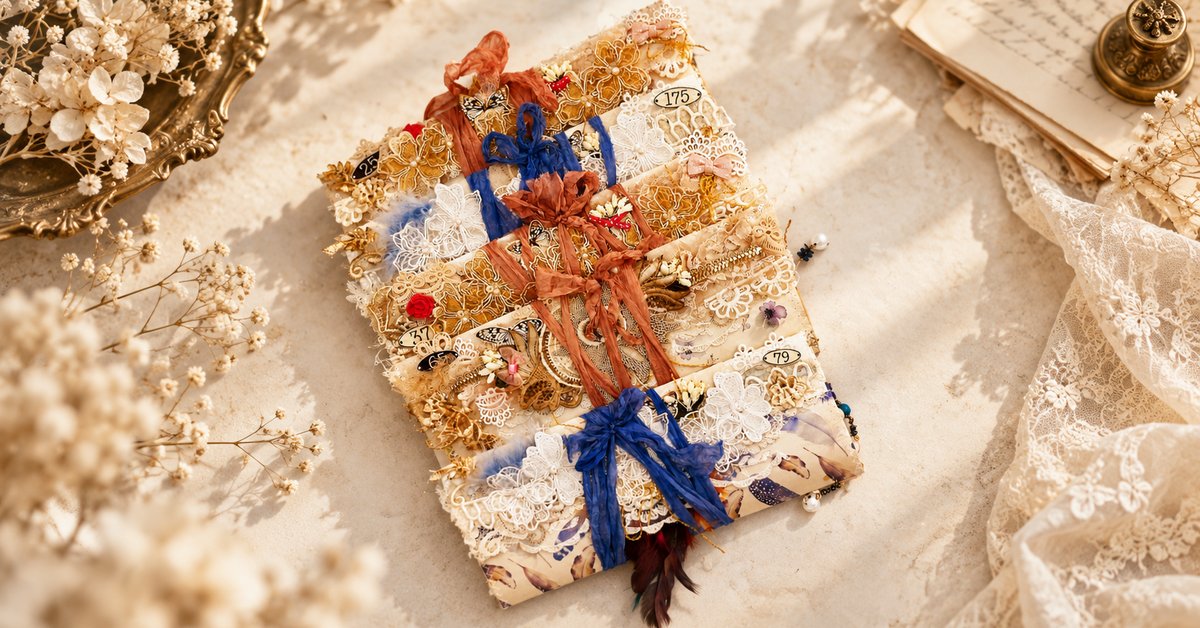
I used beautiful trims and old lace throughout, sometimes layering several pieces together.
Some of the lace was tea dyed so that it wouldn't feel too new beside the aged papers.
I particularly loved playing with the layers here — paper against fabric, embroidery against faded print, soft lace against the stronger envelope underneath.
I had also been making small bundles of some of these trims and laces at the time.
They are the sort of materials I am constantly drawn to: decorative enough to be noticed, but old and soft enough not to overpower everything else around them.
A journal becomes much more tactile when fabric enters it.
Paper gives you the image.
Lace gives you the feeling.
Timeless, Memories — Similar Journals, Different Personalities
Although these journals share the same construction, each developed its own personality.
One was called Timeless.
Another, Memories.
The names seemed appropriate because that is really what these pieces became about.
Old wedding stationery.
Paper that had already survived the closing of the shop it came from.
Vintage music pages.
Fragments of text.
Lace.
Cards.
All brought together into something designed to hold yet more pieces of somebody else's life.
There is something rather lovely about that cycle.
Materials associated with one kind of memory become a place for keeping completely new ones.
A Journal Made in Pakistan Carries Pakistan With It
Looking back at this project, what strikes me most is how naturally parts of where I live entered the journal.
I wasn't consciously trying to make a "Pakistani journal."
I was simply using materials available to me.
But there it is.
The wedding procession embossed onto the envelope.
The old wedding stationery from a local shop.
The Urdu print tucked amongst the pages.
The trims and fabrics I had collected here.
And the story I found myself telling while I flipped through the journal — explaining why the groom was going to the bride's house, why the wedding didn't happen in a single day, and why that embossed image meant what it did.
This is something I have come to value more and more in my own work.
The materials available to each of us are different.
That difference is not a disadvantage.
It is often where the most interesting work begins.
The Giveaway That Had to Wait
There is another piece of this journal's story that belonged very specifically to the moment when I filmed it.
I had originally planned to give one of these journals away internationally.
I had actually recorded the flip-through once already.
Then I checked with the post office.
At that time, postal service from Pakistan to the United States had been suspended because of uncertainty surrounding new tariffs, customs duties and how the charges were going to be handled.
I investigated FedEx as an alternative, but international courier costs for even a relatively small parcel were extremely high.
So the giveaway had to wait.
It wasn't the ending I had planned for the video.
But that is part of being a maker running a creative business from Pakistan too.
Sometimes the story isn't only about what happens at the worktable.
There is the making.
And then there is the very practical question of how something handmade travels from here into somebody else's hands on the other side of the world.
★★★★★
“I have purchased 3 of Savera’s incredible journals this year. Her materials, color selections and creativity are first rate. Everything is top quality. I am gifting one journal to a friend and selfishly keeping two for myself. I received the package here in the US in only 2 1/2 weeks! The journals were cocooned in cheesecloth inside the envelope which helped protect them from the puncture that the mail carrier made. A cheerful handmade card was included along with a free packet of pretty sprinkles. Definitely one of my very favorite shops!”
Why I Still Keep Old Things
If I had looked at those wedding envelopes only in terms of their original purpose, they probably should have disappeared when the invitation shop closed.
They were leftover stock.
Unused stationery.
Old paper.
But that is rarely how I see things.
I saw good paper.
Beautiful embossing.
Generous proportions.
A fold I could use.
A pocket waiting to happen.
And a story I already understood.
Three of those envelopes became the bones of a journal.
Everything else grew around them.
Perhaps that is why I continue to keep materials that other people might discard.
Not because every scrap is precious.
But because sometimes the thing that looks obsolete in one context is exactly what you need in another.
You Don't Need to Begin With a Perfect Kit
These journals were not made from one perfectly coordinated collection.
They grew from what I already had.
Old envelopes.
Wedding cards.
Vintage papers.
Scrapbook paper.
Music sheets.
Dyed writing paper.
Lace.
Trim.
Little fragments that happened to work together.
And I think that is an important part of creative journal making.
You can start with one remarkable material and allow everything else to gather around it.
In this case, the envelopes decided almost everything.
Their size gave me the construction.
Their embossing gave me the story.
Their history gave the journal its character.
Need Help Turning a Collection of Materials Into a Journal?
If you have papers, fabric, lace, old stationery and bits of ephemera that you love but aren't sure how to bring together, the Trinketz Kit Builder can help you develop them into a cohesive journal direction.
Start with the piece you can't bear to throw away.
Then build outwards from there.
Watch the Original Folio Journal Flip-Through
The video shows all three journals in much more detail — including the embossed envelopes, removable dyed pages, pockets, vintage papers, lace and the slight variations between each piece.
It also contains the original story behind the wedding invitations and the Pakistani wedding traditions represented on them.
When I filmed it, I said I wanted my flip-through videos to include not only journals, but also stories, discussions and little life updates.
Looking back, I think this journal explains exactly why.
Because sometimes the story of a handmade book begins long before the first page is made.
What Customers Say
★★★★★
“Beautiful journal, made very well. Packaged nicely.... Thank you!!!”
— Deanna Mills
★★★★★
“Beautiful journal, every page is an explosion of color, texture and creativity. I bought journal #2 in blue. I'm so happy with my purchase.”
— Linda Armbruster
★★★★★
“Beautiful as described and shipping arrived faster than expected. Great seller, lovely packaging - such a lovely creative and thoughtful junk journal...”
— Stephanie Weyant

Leave a comment
I’ll use your details to reply to your comment. Privacy Policy